
Agency and Resilience Artist Statement
This book lives at the intersection of two formidable women: Susan Sontag and Susan Linfield. Sontag wrote that atrocious images should haunt us — that even as incomplete tokens of a larger reality, they perform a vital function: reminding us what human beings are capable of doing, willingly, even enthusiastically. Linfield pushed further, insisting that looking at photographs of suffering is not voyeurism but the beginning of solidarity — that images of violence can be an entry point into political consciousness rather than a retreat from it. Between Sontag’s haunting and Linfield’s insistence on looking, this book found its mandate. It also found its job description.
On January 24, 2026, two federal Customs and Border Protection agents shot and killed Alex Pretti on Nicollet Avenue. Documentary journalists were present that morning — bearing witness, making photographs. What unfolded that day, and in the weeks that followed, became this book.
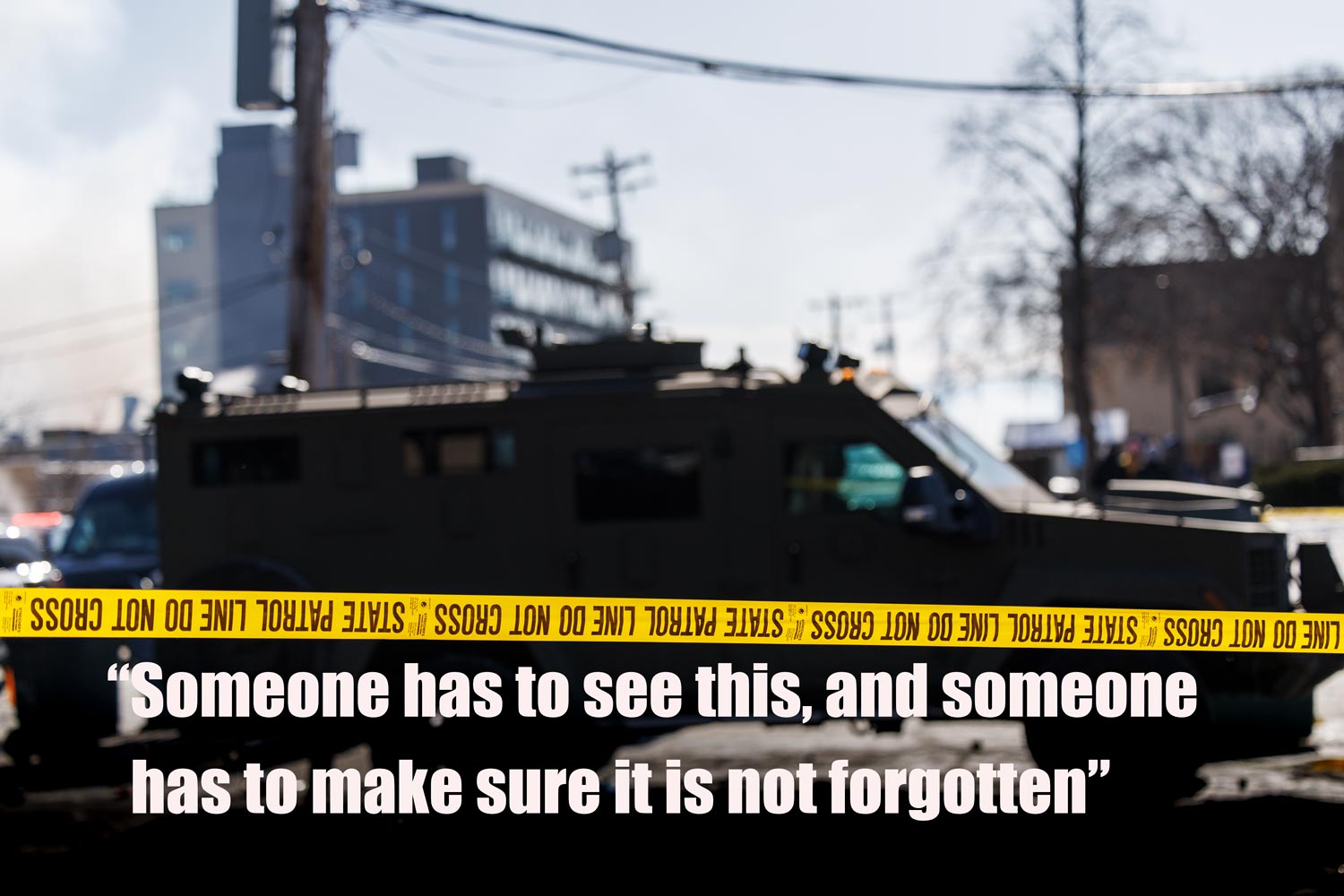 Agency & Resilience is not an argument. It is a record. The photographs, transcripts, 911 calls, press conference statements, and official communications gathered here are primary documents. They speak for themselves, and the work was to let them. To be present — at the scene, at the vigils, at the memorial, at the concert that turned a street where a man died into something that refused to stay quiet — and to make images capable of holding what was happening long enough for others to see it.
This work has always returned to communities shaped by violence at the hands of institutions — to the long aftermath, the slow reckoning, the places where historical trauma and present-day reality meet. Those stories share something with this one: the act of witnessing is not passive. It is a responsibility. And it is, in the most literal sense, transformative — not as metaphor, but as mechanism. People do not change in the abstract. They change when they can no longer look away. They change when an image or a moment breaks through the distance that makes injustice feel like someone else’s problem. Bearing witness is the thing that closes that distance. It is what turns information into reckoning.
The people who gathered on Nicollet Avenue understood that. They came with phones and flowers and handmade signs and grief they didn’t know what to do with. Many of them had never stood on a street like that before. But they came, and in coming, something shifted — in them, in the neighborhood, in the story itself. They bore witness too. And bearing witness changed them.
This book is dedicated to that instinct — the one that says: someone has to see this, and someone has to make sure it is not forgotten.
— Trench